
Artificial intelligence is moving from simple question-and-answer experiences toward systems that can carry out multi-step work. This shift is often described with terms such as AI agents, agentic AI and agentic workflows.
Instead of asking an AI system to produce one response and stopping there, an agent can be designed to understand a goal, decide what steps are needed, use approved tools, inspect the results and continue until the task reaches a defined stopping point. The exact level of autonomy varies from one system to another, so not every application marketed as an “AI agent” works in the same way.
In this guide, we will break down what AI agents are, how an AI agent works, the difference between an AI agent and a chatbot, common use cases, benefits, limitations, security concerns and practical ways businesses and individual users can start experimenting with agentic AI.
What Are AI Agents?
An AI agent is a software system that uses an AI model to pursue a goal through a sequence of decisions and actions. Unlike a basic chatbot that mainly generates a response to a prompt, an agent can interact with tools or external systems and use the results of those actions to decide what to do next.
A useful way to think about an AI agent is as a digital worker with a defined job. It may receive an objective, break that objective into smaller tasks, gather information, perform an action, verify the result and continue or ask a human for help when necessary.
For example, imagine a research agent given the task: “Prepare a competitor report.” A simple AI assistant might explain how to create the report. An agentic system could instead search approved sources, collect information, organize findings, identify missing data, create a draft and return the finished report for human review.
The important point is that AI agents are not simply smarter chatbots. Their defining feature is the ability to participate in a process and take actions within an environment rather than only generate text.
How Do AI Agents Work?
Most practical AI agents can be understood as a loop. The system receives a goal, decides what to do, uses a tool or produces an intermediate result, observes what happened and then determines the next step.
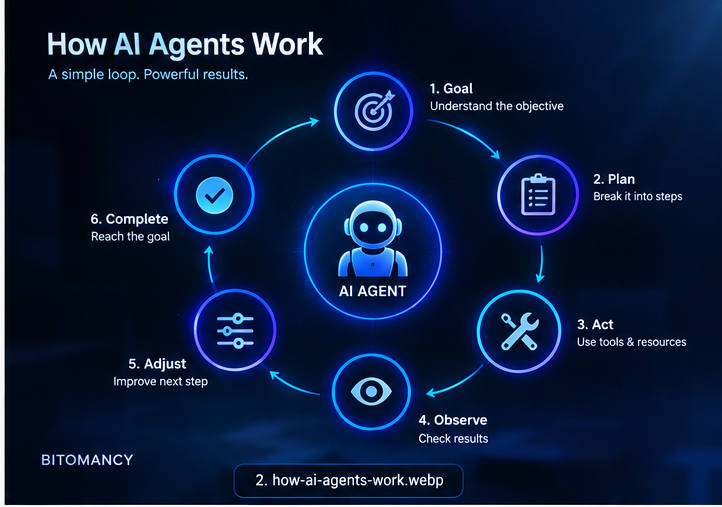
A typical agentic workflow contains several building blocks:
1. Goal or Trigger
The process starts with an instruction, event or schedule. The trigger might be a user request, a new customer message, a software alert, a scheduled task or a change in business data.
2. AI Model
The language or reasoning model interprets the task and helps determine what should happen next. It can classify information, generate plans, choose tools and evaluate intermediate results.
3. Tools
Tools allow the agent to interact with the outside world. Depending on the application, these may include web search, databases, APIs, calculators, code execution, file systems, business software or communication platforms.
4. Context and Memory
Agents need relevant information to make useful decisions. Context can include the current conversation, files, previous steps, business rules and information retrieved from connected systems. Some systems also maintain longer-term state or memory.
5. Feedback and Observation
After taking an action, the agent can inspect the result. If the result is incomplete or an error occurs, the agent may adjust its approach, try another permitted action or request human input.
6. Guardrails and Human Approval
Good agent design includes boundaries. High-impact actions can require approval, sensitive tools can be restricted, and the system can be given limits on what it is allowed to access or change.
AI Agent vs Chatbot: What Is the Difference?
The easiest distinction is conversation versus task execution. A traditional chatbot is usually optimized to respond to a user's message. An AI agent is designed to work toward an objective that may require several actions.
| Feature | Traditional Chatbot | AI Agent |
|---|---|---|
| Primary role | Answer or generate | Complete a goal |
| Workflow | Often one or a few turns | Can involve multiple steps |
| Tools | May have limited integrations | Can dynamically use approved tools |
| Decision making | Mostly response generation | Chooses actions within defined limits |
| Feedback loop | Usually limited | Can observe results and continue |
The boundary is not absolute. Modern assistants can include tools and workflows, while some agents may be tightly constrained. The term “agent” is best understood as describing a system's ability to pursue a task with some degree of independent decision-making and action.
Common Types of AI Agents
There is no single architecture that fits every problem. Developers can build a focused single agent, connect multiple specialist agents or combine agents with predefined workflows.
Single AI Agents
A single agent handles a defined task using a model, instructions and a set of tools. This approach is often easier to test and maintain because one component owns the task.
Multi-Agent Systems
A multi-agent system divides work between specialized agents. For example, one agent could research information, another could analyze it and a third could review the output. The extra coordination can be useful for complex projects but also introduces additional failure points.
Agentic Workflows
Some tasks are better handled by predictable workflows rather than fully autonomous agents. A workflow can define fixed steps while using an AI model where flexibility is useful. This can make the process easier to control and evaluate.
Real-World AI Agent Use Cases
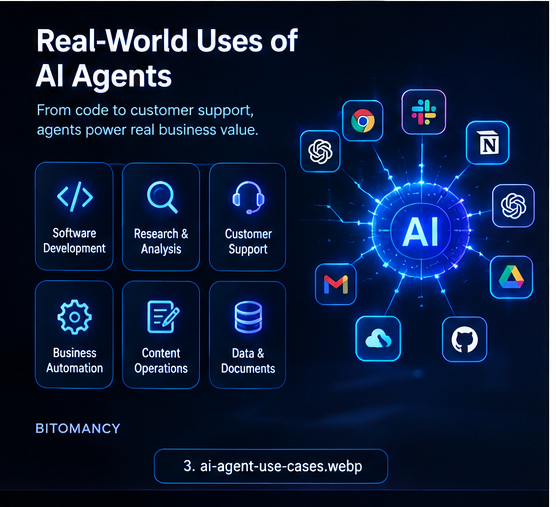
AI agents are especially interesting when a task involves multiple steps, external information and a clear definition of success. Here are several areas where agentic systems can be applied.
Software Development
Coding agents can inspect repositories, understand issues, modify files, run tests and iterate on fixes. Human review remains important, particularly when an agent can change production code or access sensitive systems.
Customer Support
A support agent can identify a customer's issue, retrieve account information, search a knowledge base and perform approved actions. More complex cases can be escalated to a human support representative.
Research and Analysis
Research agents can gather information from approved sources, compare findings, organize evidence and create structured reports. Their usefulness depends heavily on source quality and verification.
Marketing and Content Operations
Agents can support content research, keyword clustering, content briefs, social-media workflows, campaign analysis and repetitive publishing tasks. Human editorial review is still valuable for accuracy, originality and brand voice.
Business Automation
Businesses can use agents to connect repetitive processes across email, spreadsheets, databases, CRM systems and internal tools. The agent can make decisions within predefined rules and request approval for actions that require human judgment.
Personal Productivity
Personal agents can organize information, summarize documents, prepare drafts, manage recurring workflows and coordinate information across approved tools. The safest implementations give the agent only the permissions it actually needs.
Smart Copy PRO
Turn copied text into summaries, professional emails and LinkedIn-ready content in seconds.
Get Smart Copy PRO →Benefits of AI Agents
The biggest potential benefit of AI agents is not simply generating content faster. It is reducing the amount of manual coordination required to complete a process.
- Automation: Agents can handle repetitive multi-step processes that previously required manual coordination.
- Speed: Several information-gathering and processing steps can be performed without waiting for a person between every stage.
- Tool use: Agents can connect AI capabilities with software, databases and other systems.
- Scalability: Once a workflow is reliable, organizations can run it repeatedly with consistent instructions and controls.
- Adaptability: Unlike a completely fixed script, an agent can adjust its next step when the environment changes or a tool returns an unexpected result.
Risks and Limitations of AI Agents
More autonomy also means more responsibility. An agent that can take actions can cause larger problems than a chatbot that only produces text.
Incorrect Decisions
An agent can misunderstand a goal, select an inappropriate tool or act on incorrect information. Multi-step errors can compound because one incorrect result may influence later decisions.
Security and Prompt Injection
Agents that read external content or interact with tools can face attacks designed to manipulate their behavior. Strong permission boundaries, input handling, tool restrictions and monitoring are important parts of an agent security strategy.
Privacy
An agent may need access to files, emails, databases or business systems. Giving it broad access when it only needs a small subset of information increases the potential impact of an error or security incident.
Cost and Latency
Agents may make several model calls and tool calls for a single task. That can increase processing time and operating costs compared with a simple one-shot AI response.
Lack of Predictability
A fixed software workflow generally follows known paths. An agent can choose different paths depending on the situation. This flexibility is useful, but it makes testing and evaluation more important.
How to Start Using AI Agents
You do not need to automate an entire business to begin experimenting with agents. A better starting point is one repetitive task with a clear outcome.
- Choose one process: Pick a task that is repetitive and measurable.
- Define the goal: Write down exactly what successful completion means.
- List the required tools: Identify the data sources, APIs, files or applications the system actually needs.
- Set permissions: Start with the minimum access required. Keep sensitive or irreversible actions behind approval steps.
- Test with real examples: Create a test set containing normal cases, unusual inputs and known failure scenarios.
- Measure results: Track accuracy, completion rate, cost, time and human intervention.
- Expand slowly: Add tools and autonomy only after the basic workflow is reliable.
Are AI Agents the Future of Automation?
AI agents are an important direction in automation because they connect language models with real actions. Instead of treating AI as a separate chat window, an agent can become part of an existing workflow.
However, the most useful agent is not necessarily the one with the greatest autonomy. For many tasks, a simple workflow with a few carefully controlled AI steps may be more reliable, cheaper and easier to audit. The practical goal should be to use the smallest amount of autonomy needed to solve the problem effectively.
As models become better at reasoning, tool use, computer interaction and handling long-running tasks, the range of work that can be supported by agents is likely to expand. At the same time, evaluation, security, permissions and human oversight will remain essential.
Key Takeaways
- AI agents are systems designed to pursue goals through multiple steps rather than only answer a single prompt.
- They can use tools, retrieve information, observe results and adapt their next action within defined boundaries.
- Common applications include coding, customer support, research, marketing, business automation and productivity.
- More autonomy can create more value, but it can also increase cost, security exposure and the impact of mistakes.
- The safest approach is to start with a focused task, use minimum permissions and add human approval for high-impact actions.
Frequently Asked Questions
What is an AI agent in simple words?
An AI agent is an AI-powered system that can work toward a goal by deciding what steps to take, using approved tools and checking the results instead of only giving a single response.
What is the difference between AI and an AI agent?
AI is a broad field covering systems that perform tasks such as prediction, classification or generation. An AI agent is a particular kind of AI-powered system designed to pursue a task through actions and decisions, often using tools.
Can AI agents work without humans?
Some agents can perform parts of a workflow with limited intervention, but the appropriate level of autonomy depends on the task. For sensitive, expensive or irreversible actions, human approval and clear controls are important.
Are AI agents expensive?
They can be. A multi-step agent may use several model calls, tool calls and external services. Costs depend on the model, task length, tools and frequency of execution.
Are AI agents safe?
Safety depends on how the system is designed and deployed. Permissions, sandboxing, tool restrictions, monitoring, testing, secure data handling and human approval can reduce risk, but no agent should be assumed to be error-free.
Conclusion
AI agents represent a shift from AI that mainly responds to AI that can participate in a process. By combining models with tools, context, feedback loops and clearly defined permissions, agents can help automate work that previously required many manual steps.
The key is not to give an AI system unlimited control. Start with a narrow objective, make its actions observable, restrict its access, test it against realistic failures and keep people involved wherever mistakes could have significant consequences.
For individuals and businesses exploring the next generation of automation, understanding AI agents now can make it easier to identify which tasks are genuinely suitable for agentic systems—and which are better handled by a simpler workflow.
Explore More on BITOMANCY
Want more practical AI and technology guides? Visit the BITOMANCY homepage for more articles on artificial intelligence, automation, SEO and emerging technology.