
Computers can process billions of numbers in seconds, but understanding what is happening inside an image or video is a very different challenge. Computer vision is the branch of artificial intelligence that gives machines the ability to interpret visual information and extract meaningful insights from it.
From smartphones recognizing faces to autonomous vehicles detecting pedestrians, computer vision is becoming an important part of modern technology. It is also transforming healthcare, manufacturing, retail, agriculture, security, robotics, entertainment and many other industries.
But how does a machine actually "see"? What technologies make computer vision possible? And why is this field becoming increasingly important as AI evolves?
In this guide, BITOMANCY explores what computer vision is, how computer vision works, its major applications, benefits, limitations and future possibilities.
1. What Is Computer Vision?
Computer vision is a field of AI and computer science focused on enabling computers to interpret and understand information contained in images, videos and other visual inputs.
Humans can look at a photograph and immediately identify objects, people, colors, locations and actions. Computer vision attempts to provide machines with a similar capability using cameras, algorithms, machine learning and neural networks.
A computer vision system can be trained to answer questions such as:
- What objects are present in an image?
- Where are those objects located?
- Is a particular person present?
- What is happening in a video?
- Is an object damaged or defective?
- Does an image contain a particular pattern?
- How does one image differ from another?
In simple terms, computer vision converts visual data into useful information that software can understand and act upon.
2. How Does Computer Vision Work?
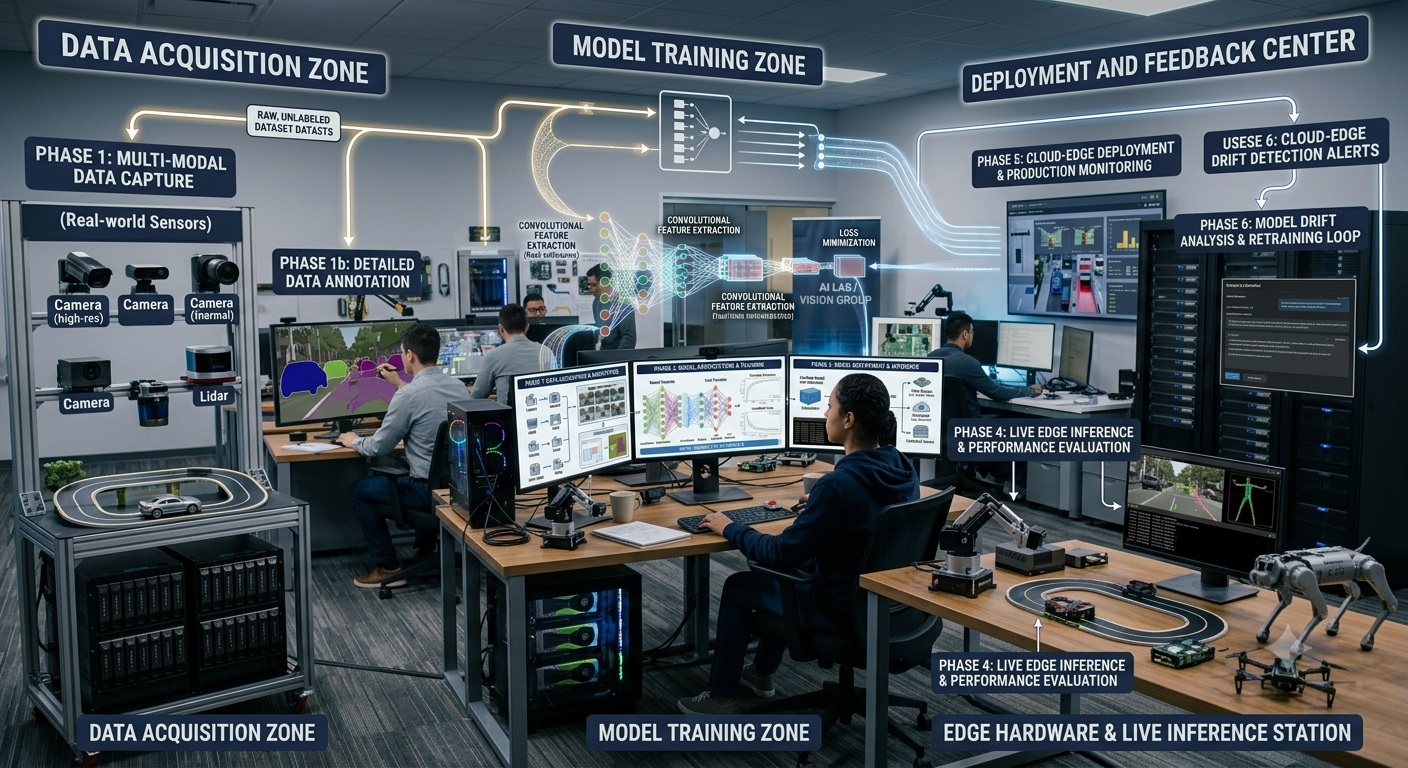
Computer vision generally combines cameras or other visual sensors with image-processing techniques and AI models. The exact architecture depends on the task, but the process can be understood through several stages.
Step 1: Capturing Visual Data
The system first receives visual information from a camera, smartphone, surveillance system, medical scanner, satellite or another sensor.
Step 2: Processing the Image
The captured image can be resized, normalized, enhanced or otherwise prepared before being analyzed by an AI model.
Step 3: Extracting Visual Features
AI systems identify patterns within the visual input. These patterns can include edges, shapes, textures, colors and increasingly complex features.
Step 4: AI Model Analysis
A trained machine-learning or deep-learning model processes these features and predicts what the image contains or what is happening within it.
Step 5: Producing an Output
The system then generates a useful result. This could be an object label, a detected location, a classification, a measurement, an alert or an automated action.
3. Key Technologies Behind Computer Vision
Modern computer vision is powered by several technologies working together.
Machine Learning
Machine learning enables computers to identify patterns from examples rather than relying entirely on manually programmed rules.
Deep Learning
Deep learning uses multi-layer neural networks to learn increasingly sophisticated representations of visual information. It has played a major role in the rapid development of modern computer vision.
Convolutional Neural Networks
Convolutional neural networks, commonly called CNNs, became highly influential in image recognition because they can learn useful spatial patterns within images.
Object Detection
Object detection identifies both what an object is and where it appears within an image. For example, a system could identify several cars and pedestrians in a street scene.
Image Classification
Image classification assigns an image to one or more categories. A model might classify an image as containing a dog, a vehicle, a landscape or a particular type of product.
Image Segmentation
Segmentation goes further by identifying individual pixels or regions belonging to particular objects. This can be extremely useful in medical imaging, robotics and industrial inspection.
Optical Character Recognition
OCR technology enables computers to extract text from photographs, scanned documents, receipts, signs and other visual sources.
4. Computer Vision vs. Traditional Image Processing
Traditional image processing generally relies on predefined mathematical techniques and manually designed rules. Computer vision increasingly uses machine learning to learn useful patterns directly from data.
For example, a traditional system might be programmed to search for a specific shape or color. A modern AI model can instead be trained using thousands or millions of examples and learn which visual characteristics are useful for recognizing an object.
This shift from hand-designed rules to data-driven learning has significantly expanded what machines can accomplish with visual information.
5. Real-World Applications of Computer Vision
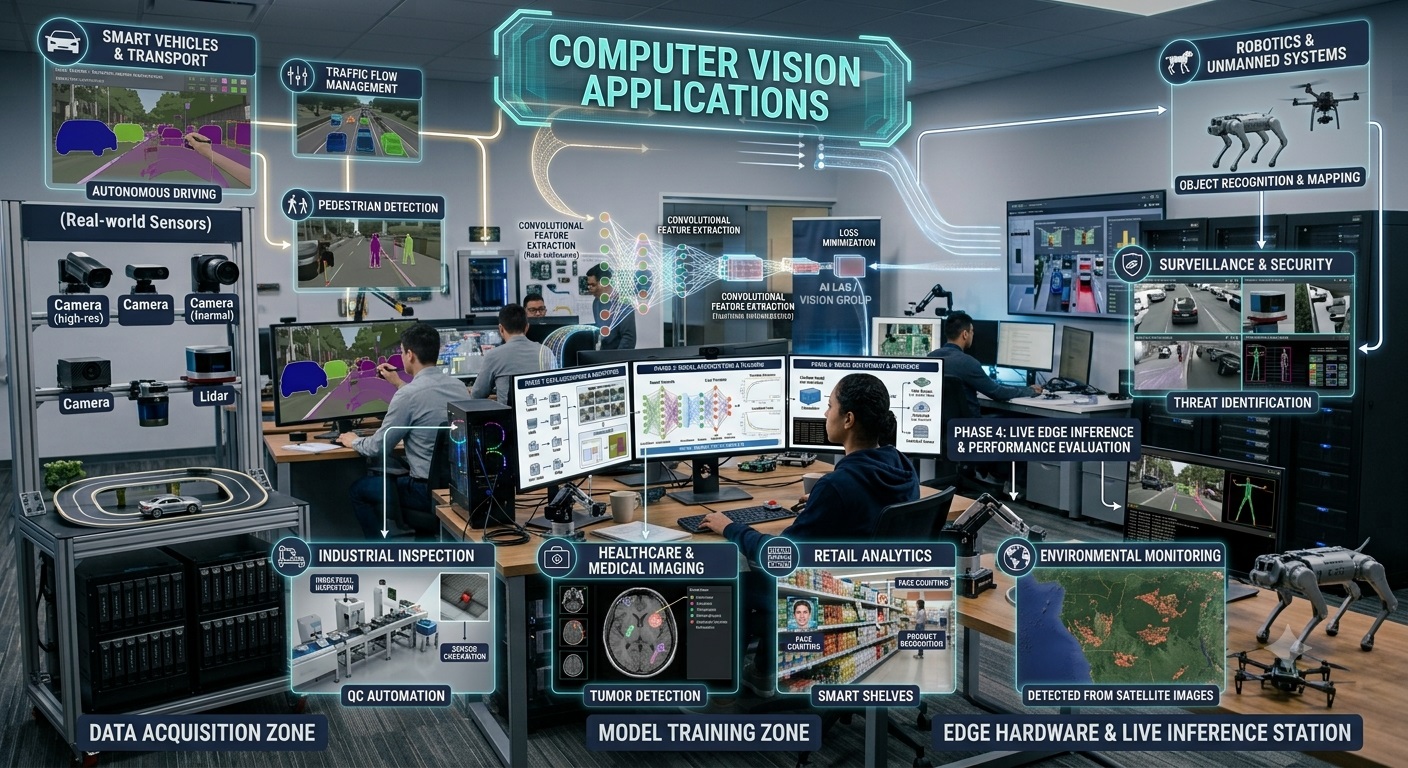
Computer vision is no longer limited to research laboratories. It is already being used across a wide range of industries.
Healthcare
Computer vision can assist medical professionals by analyzing medical images such as X-rays, CT scans, MRI images and other diagnostic imagery.
AI systems can help identify patterns that may require further examination. They are designed to assist professionals rather than replace medical judgment.
Autonomous Vehicles
Self-driving and driver-assistance technologies use cameras and other sensors to understand road environments.
Computer vision can help detect lanes, vehicles, pedestrians, traffic signs and other road objects, allowing an intelligent driving system to make decisions based on its surroundings.
Manufacturing
Factories can use computer vision for automated quality inspection. Cameras can inspect products for scratches, cracks, missing components, incorrect assembly or other defects.
Retail
Retail businesses can use visual AI for inventory monitoring, checkout automation, product recognition and customer analytics.
Agriculture
Computer vision can analyze crops, leaves and fields to help detect plant diseases, estimate crop conditions and identify areas that require attention.
Security and Surveillance
Visual AI can analyze video streams to detect objects, unusual activities, restricted-area access and other predefined events.
Robotics
Robots need to understand their environments to interact with physical objects. Computer vision can help robots locate objects, navigate spaces and perform tasks requiring visual perception.
Smart Copy PRO
Turn copied text into summaries, professional emails and LinkedIn-ready content in seconds.
Get Smart Copy PRO →6. Computer Vision and Generative AI
One of the most interesting developments in AI is the convergence of computer vision and generative AI.
Earlier computer vision systems were often designed for specific tasks such as classification or detection. Modern multimodal AI systems can combine visual understanding with language capabilities.
This allows AI systems to perform tasks such as:
- Describing images in natural language
- Answering questions about photographs
- Reading and interpreting documents
- Analyzing charts and diagrams
- Understanding screenshots
- Comparing visual information
- Combining images with text-based reasoning
The result is a move toward AI systems that can understand multiple types of information rather than treating text, images and other data as completely separate inputs.
7. Benefits of Computer Vision
Organizations adopt computer vision because visual information can contain valuable data that is difficult or expensive to analyze manually.
- Automation: Visual inspection and repetitive tasks can be automated.
- Speed: AI systems can analyze large quantities of visual information rapidly.
- Consistency: Automated inspection can apply the same rules repeatedly.
- Scalability: Computer vision can process visual data from thousands of cameras or devices.
- Operational efficiency: Businesses can identify problems earlier and reduce manual workloads.
- New capabilities: Machines can interact with environments in ways that were previously difficult to automate.
8. Challenges and Limitations
Despite its impressive capabilities, computer vision is not perfect. AI models can make mistakes, particularly when visual inputs are unclear, unusual or outside their training distribution.
Data Quality
Poor-quality, incomplete or biased training data can negatively affect model performance.
Privacy
Systems that analyze faces, people and locations can create significant privacy considerations. Responsible deployment requires appropriate safeguards and compliance with applicable laws.
Bias
If training data does not adequately represent different environments or populations, a computer vision system may perform differently across groups or conditions.
Computational Requirements
Advanced vision models can require substantial computing resources, especially when processing high-resolution images or real-time video.
Unpredictable Environments
Lighting changes, camera angles, weather, occlusion and unusual objects can make visual recognition more difficult.
9. The Future of Computer Vision
The future of computer vision is moving toward systems that are more capable, multimodal and context-aware.
Instead of simply recognizing an object, future AI systems will increasingly be expected to understand what is happening, why it matters and what action should follow.
This could lead to more capable robots, intelligent manufacturing systems, advanced medical-assistance tools, smarter transportation systems and AI assistants that can understand the physical world.
Edge AI is another important direction. Rather than sending every image to a remote server, some computer vision tasks can be processed directly on smartphones, cameras, vehicles, industrial devices and other edge hardware. This can reduce latency and potentially improve privacy and reliability.
10. Is Computer Vision Important for the Future of AI?
Yes. Vision is one of the most important ways humans interact with the physical world, so machines that can understand visual information have enormous potential.
Computer vision is also becoming increasingly connected with other AI technologies. When visual understanding is combined with language, reasoning, robotics and real-time data, AI systems can move beyond simply analyzing information toward interacting with the world around them.
This makes computer vision an important component of the broader shift toward multimodal and embodied artificial intelligence.
Key Takeaways
- Computer vision enables machines to analyze and understand visual information.
- Modern computer vision relies heavily on machine learning and deep learning.
- Object detection, image classification, segmentation and OCR are major computer vision technologies.
- Computer vision is used in healthcare, manufacturing, agriculture, retail, robotics and transportation.
- Generative AI is increasingly combining visual understanding with natural-language reasoning.
- Privacy, bias, data quality and computational requirements remain important challenges.
- The future of computer vision is likely to involve more multimodal, real-time and context-aware AI systems.
Frequently Asked Questions
What is computer vision in simple words?
Computer vision is a field of AI that enables computers to analyze images and videos and extract useful information from them.
How does computer vision work?
Computer vision systems capture visual data and use image processing, machine learning and neural networks to identify patterns, objects and other information.
What is an example of computer vision?
Face recognition on a smartphone, automatic defect detection in a factory and a vehicle detecting pedestrians are examples of computer vision applications.
Is computer vision part of AI?
Yes. Computer vision is an important field within artificial intelligence and overlaps with machine learning, deep learning, robotics and other areas of computing.
What is the difference between computer vision and image recognition?
Image recognition is generally focused on identifying or classifying visual content, while computer vision is a broader field that includes recognition, detection, segmentation, tracking, interpretation and other visual tasks.
Will computer vision replace humans?
Computer vision can automate specific visual tasks, but many real-world applications still require human judgment, context and responsibility. In many industries, the more practical role of AI is to assist people rather than completely replace them.
Conclusion
Computer vision is giving machines a new way to understand the world. From analyzing medical images and inspecting products to helping robots navigate environments, visual AI is becoming an important technology across modern industries.
The biggest transformation may come from combining computer vision with generative AI, language models, robotics and real-time computing. Such systems could move beyond recognizing what they see and begin to understand visual situations in a much more meaningful way.
As AI continues to evolve, the ability to see, interpret and respond to the physical world could become one of the defining capabilities of intelligent machines.
Explore More on BITOMANCY
Want more practical AI and technology guides? Visit the BITOMANCY homepage for more articles on artificial intelligence, automation, SEO and emerging technology.