If your Search Console graph looks different from last week, you are not alone. SEO trackers and forums have been reporting unconfirmed ranking swings for weeks, and the conversation tends to jump to one question: is a new core update coming? As of early November, Google's Search Status Dashboard lists no core update after May 2026, so the honest answer is that nobody outside Google knows.
This guide separates what is confirmed from what is rumour, shows a seven-day method for diagnosing a traffic change, and gives you a short list of fixes that are worth doing whether or not an update is on the way. It reflects public reports and Google's own documentation as of 10 November 2026.
What has actually happened in 2026
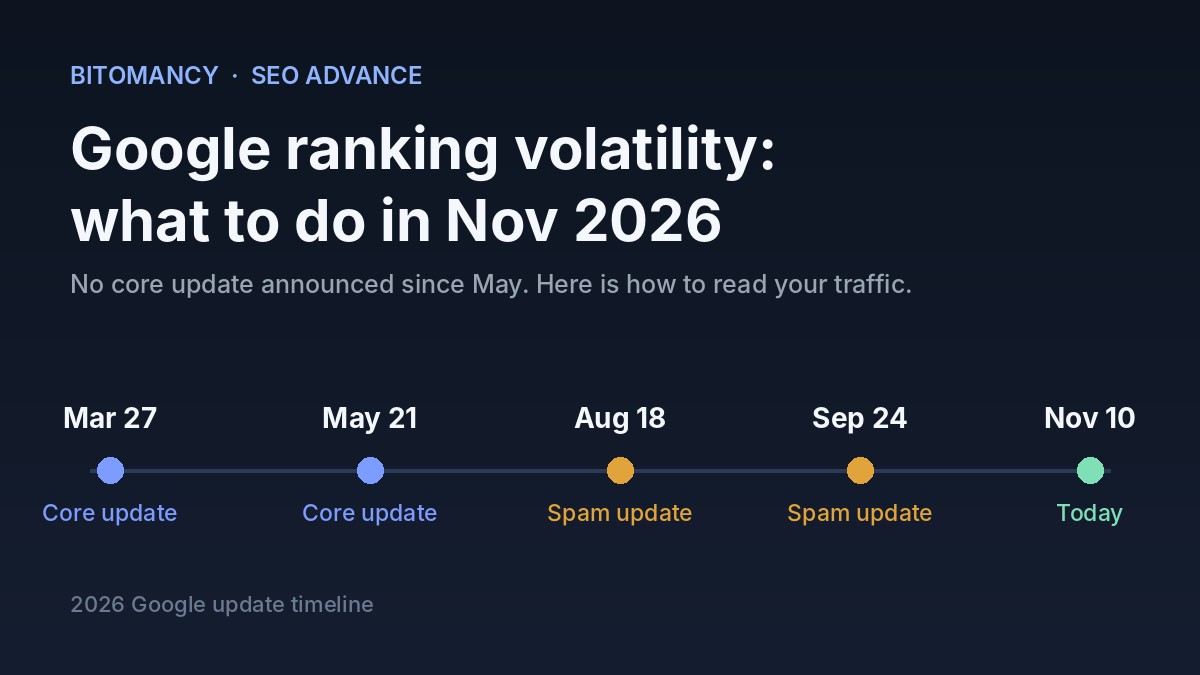
Most of the noise makes sense once you lay the confirmed updates on a calendar. Two broad core updates have rolled out this year, and the spam updates have been frequent and long.
| Update | Type | When |
|---|---|---|
| March 2026 | Core | Started 27 March, rolled out for about 12 days |
| May 2026 | Core | Started 21 May, completed 2 June |
| August 2026 | Spam | Started 18 August, finished by 21 August |
| September 2026 | Spam | Started 24 September in phases, finished 8 October |
Since then, reports of ranking volatility have continued through October, including an unconfirmed spike on 27 October. Unconfirmed means exactly that: tracking tools and community chatter saw movement, and Google has not said why. Google has also said that it does not start rolling out updates before announcing them, so a spike with no announcement is not automatically a core update.
A seven-day method to read a traffic change
Resist the urge to rewrite pages the moment a line dips. Google's own guidance on core updates advises waiting before drawing conclusions, then comparing a clean week against a clean week. You can apply the same discipline to any volatility.
- Day 1: confirm it is real. Open Search Console, go to Performance, and compare the last seven days with the seven days before. Check that the drop is in clicks and impressions, not just a one-day blip or a holiday effect.
- Day 2: find where it landed. Break the change down by page, by query, by country and by device. A drop across the whole site points to a site-level issue. A drop in a few pages points to those pages or their topics.
- Day 3: check the basics. Look at the Pages report for new indexing problems, the Security and Manual Actions section for any notice, and the Crawl stats for a sudden rise in server errors.
- Day 4: compare with the calendar. Check the Google Search Status Dashboard to see whether a confirmed update overlaps your dates.
- Days 5 to 6: review the content that fell. Open the affected pages as a stranger would. Is it genuinely helpful, original and current, or could ten other sites have written the same thing?
- Day 7: decide. Fix specific problems you found, leave the rest alone, and re-measure a week later.
What the pattern usually means
| What you see | Likely cause | Sensible response |
|---|---|---|
| Impressions fall, average position steady | Fewer searches, seasonality or more AI answers | Improve titles and snippets, track branded searches |
| A handful of pages lose positions | Stronger competing pages or thin content | Add original detail, examples and fresh facts |
| Whole site drops after a confirmed update | Broad quality reassessment | Audit quality site-wide and wait for the next update to see recovery |
| Sharp drop right after a spam update | Spam policy issue such as scaled low-value pages or paid links | Remove or rework the offending pages and links |
| Pages disappear from results | Indexing, canonical or robots problem | Fix the technical error, then request re-indexing |
One caution on timing: recovery from a quality-related drop is not quick. One agency's estimate is three to six months, and longer if you must wait for the next core update to see your improvements counted. That is a reason to improve steadily, not to panic-edit.
Tidy your titles and descriptions
Pages that lost clicks often have weak snippets. Use BITOMANCY's free Meta Description Helper to draft concise, search-friendly descriptions, and the Blog Outline Generator to plan a stronger rewrite. No sign-up needed.
Open free tools →Five fixes worth making this week
These do not depend on any rumour. They are the kind of work that holds up across updates.
1. Show a real person and real experience
Add a named author and a short bio to every article, and link it to an About page that explains who you are. Google's guidance keeps returning to experience, expertise and trust, and readers can tell the difference between a page written by someone who has done the thing and one rewritten from other pages.
2. Cut or rework thin and near-duplicate pages
A smaller site of genuinely useful pages beats a larger one padded with repeats. Merge overlapping posts, delete anything that adds nothing, and give each remaining page one clear purpose. Google's spam policies specifically call out content produced at scale mainly to rank.
3. Stay away from bought links and manufactured citations
Buying links has long been against the rules, and reporting this year indicates that Google has extended its spam policies to cover manipulating or buying citations in AI search features. Earn mentions by publishing something worth citing, such as original data, a useful tool or a clear explainer. Our guide to ranking in AI search covers the answer-first format that earns citations honestly.
4. Keep dates, prices and facts accurate
Update the date on a page only when you have genuinely changed it. Google has said incorrect lastmod dates in sitemaps are unhelpful, and it is better to leave them out than to get them wrong. If your articles contain prices or offers, check them regularly.
5. Get your structured data right before the shopping rush
Black Friday falls on 27 November and Cyber Monday on 30 November, and Google continues to add shopping features to search. If you sell anything, make sure product markup is accurate. We hit this on our own shop page: Search Console flagged a Product snippets error because the markup had no offer or review data. The fix was to describe items honestly rather than add fake ratings. Never invent reviews to satisfy a validator.
Smart Copy PRO
Turn copied text into summaries, professional emails and LinkedIn-ready content in seconds. Handy for writing meta descriptions, outreach emails and quick page summaries.
Get Smart Copy PRO → See all productsWhat not to do
- Do not rewrite everything at once. You will lose the signal about what worked.
- Do not chase every forum rumour. Unconfirmed volatility is a reason to measure, not a reason to change course.
- Do not mass-produce pages with AI. Our guide on using Python and AI for SEO shows how to automate the dull parts while a human keeps the final say.
- Do not copy a competitor's article. Original examples and real experience are what you can offer that a rewrite cannot.
If you are building the foundation from scratch, our complete SEO system guide and the AdSense approval checklist walk through the quality basics in order.
Key Takeaways
- No Google core update is listed after May 2026, so recent swings are unconfirmed, not an announced update.
- Diagnose with a calm seven-day comparison in Search Console before changing anything.
- Match the pattern to the cause: a few pages points to content, the whole site points to quality or spam.
- Real authors, original content and accurate data matter more than any single trick.
- Earn links and citations by being worth citing, and never buy them or invent reviews.
Frequently Asked Questions
Is there a Google core update in November 2026?
None has been announced as of early November. The most recent core update on Google's dashboard is May 2026, which completed on 2 June. Volatility without an announcement may be a smaller change, a spam-related adjustment or normal fluctuation.
How long should I wait before reacting to a ranking drop?
Wait at least a week, then compare a full clean week with the week before. After a confirmed core update, wait until it has finished rolling out before judging the impact.
Will fixing my content bring rankings back quickly?
Usually not. Quality improvements tend to take months to show, particularly if a site must wait for the next core update to be reassessed. Steady improvement is the realistic path.
Are backlinks still worth building?
Yes, when they are earned. Useful tools, original research and clear guides attract links naturally. Paid links and manufactured mentions risk breaking Google's spam policies.
Conclusion
Ranking swings feel urgent, but the winning response is usually calm and unglamorous: measure carefully, fix real problems, and keep publishing work that a real person with real experience would be proud of. Use the next seven days to run the diagnosis above, make the five fixes that apply to you, and check back after a clean week of data.
How we checked
This article was prepared on 10 November 2026 from Google's own documentation and public reporting. BITOMANCY is independent and not affiliated with Google. For the official picture, see Google's core updates guidance and the Search Status Dashboard. For community reports on volatility, Search Engine Roundtable keeps a running log. If something here has changed, let us know and we will update it.
Explore More on BITOMANCY
Want more practical AI and technology guides? Visit the BITOMANCY homepage for more articles on artificial intelligence, automation, SEO and emerging technology.