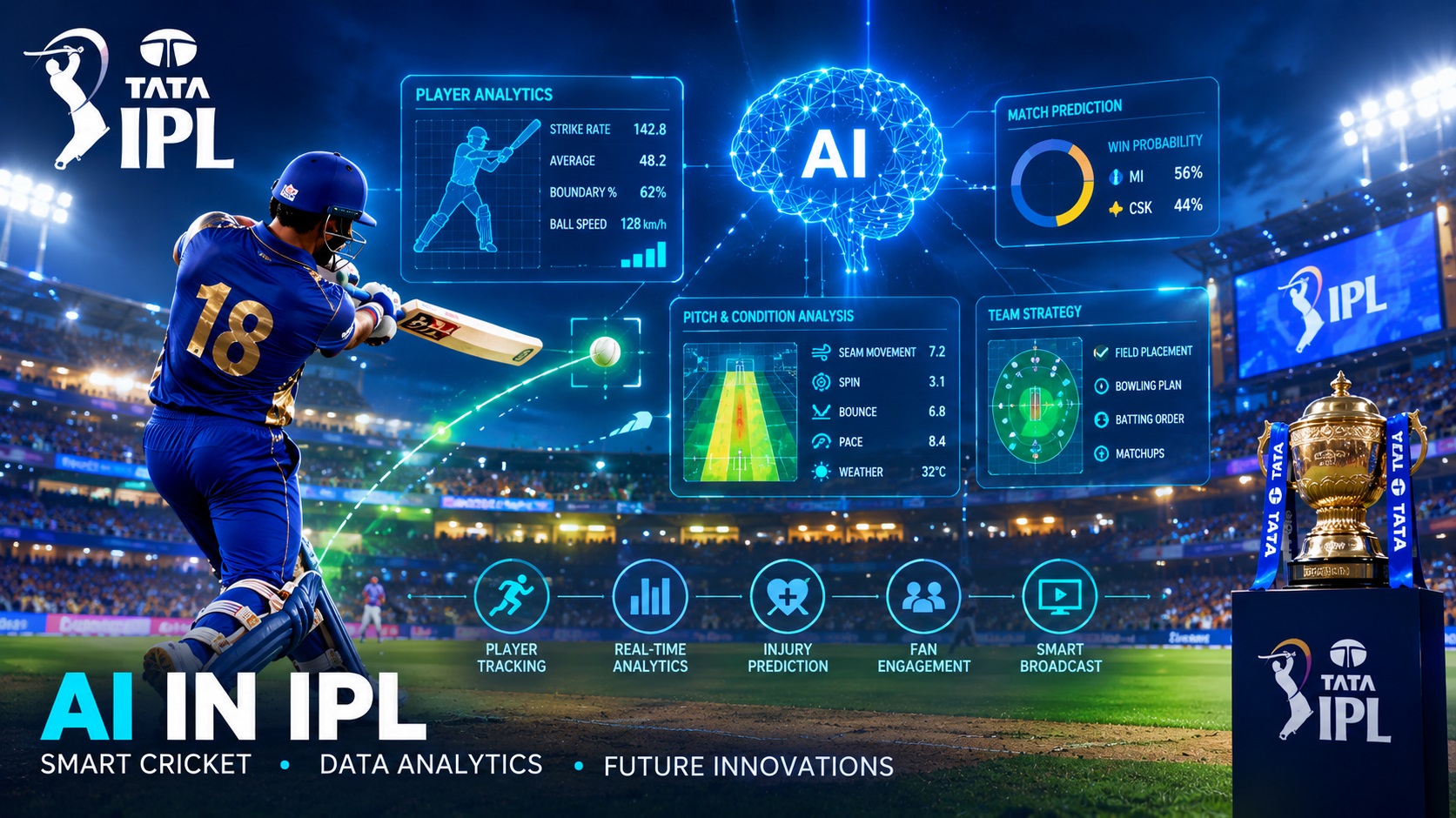
Cricket has always been a game of instinct, skill and strategy. But modern cricket is also becoming a game of data.
Every delivery can generate information about speed, movement, pitch location, shot selection, field placement and match conditions. Every training session can produce performance data. Every IPL match can create thousands of events that can be analysed long after the players leave the field.
This is where artificial intelligence in cricket becomes increasingly important.
The Indian Premier League has evolved into one of the world's most data-rich sporting competitions. Teams are no longer looking only at runs and wickets. They can examine player matchups, phase-wise performance, bowling patterns, workload, field positions and countless other variables.
The next step is to make this information more intelligent.
AI in IPL could transform cricket from data-driven decision-making into real-time intelligent decision-making.
What Is AI in IPL?
AI in IPL refers to the use of artificial intelligence, machine learning, computer vision, predictive analytics and automated data processing to understand cricket performance and support decisions.
Instead of simply displaying statistics, AI systems can search for patterns within large datasets.
For example, an AI model could analyse how a batter performs against different bowling styles, how a bowler's effectiveness changes during different phases of an innings or how field placements influence scoring opportunities.
The goal is not to remove human decision-making.
The goal is to give players, coaches, analysts, broadcasters and fans better information at the right time.
1. AI Could Transform IPL Player Performance Analysis
Traditional cricket statistics tell us what happened.
Advanced AI systems could help explain why it happened.
A batter's average might show overall performance, but AI can analyse much more: shot selection, bowling length, release point, match situation, field configuration, opposition style and scoring zones.
This creates a much more detailed picture of a player's strengths and weaknesses.
Coaches could use these insights to create personalised training plans instead of relying only on general statistics.
2. AI-Powered Player Scouting
Finding the next great IPL player is a difficult scouting problem.
Talent can come from domestic cricket, international leagues, age-group competitions and lesser-known tournaments.
AI could help teams analyse huge numbers of players using consistent performance indicators.
A scouting model could evaluate factors such as strike rotation, boundary percentage, bowling variations, economy under pressure, performance against different matchups and consistency across conditions.
This could help analysts identify players who may not receive attention through traditional scouting methods.
The result could be a more data-informed approach to recruitment and squad construction.
3. Smarter IPL Auction Strategy
The IPL auction is a complex decision-making environment.
Teams must balance player quality, squad roles, budget constraints, overseas-player limits and tactical requirements.
AI can potentially simulate thousands of auction scenarios before the event begins.
A team could ask questions such as:
- What happens if we spend heavily on a top-order batter?
- What if we prioritise a specialist death bowler?
- Which combination provides the strongest balance within the available budget?
- Which players could provide similar performance at a lower acquisition cost?
Instead of relying on one predicted auction plan, teams could evaluate many possible scenarios before making high-value decisions.
4. AI Could Improve Match Strategy in Real Time
T20 cricket moves extremely quickly.
Captains and coaches have only seconds to respond to changing match situations.
AI could analyse the current game state and compare it with historical situations.
For example, a system could evaluate the probability of success for different bowling options, field configurations or batting matchups.
It could potentially answer questions such as:
- Which bowler is most effective against the current batter?
- Which field position is leaving the most exploitable gap?
- Should the team attack or defend during the next over?
- Which batter is best suited to the current bowling combination?
The captain would still make the final decision. AI would simply provide another layer of intelligence.
5. Computer Vision Can Make Cricket More Intelligent
One of the most exciting areas of AI in cricket is computer vision.
Cameras can capture player movements, ball trajectories and field positions.
Computer-vision systems can analyse these images and convert visual information into structured data.
That can enable advanced analysis of:
- Player movement
- Fielding positions
- Running speed
- Bowling action
- Bat swing
- Ball trajectory
- Reaction time
Over time, this could create an extremely detailed digital record of how players move and perform.
6. AI and Injury Prediction
Player availability is one of the biggest challenges for professional cricket teams.
AI could combine training workload, movement patterns, fitness information and historical injury data to identify potential risk signals.
The objective would not be to predict injuries with certainty.
Instead, AI could identify situations where a player's workload or physical indicators appear unusual.
Medical and performance professionals could then investigate those signals and decide whether training intensity or recovery plans should change.
This could become particularly valuable during long tournaments where players have limited recovery time.
7. AI Could Revolutionize Batting Analytics
Modern batting analysis can go far beyond runs and strike rate.
AI could analyse a batter's performance against specific bowling types, release points, lengths, angles and field settings.
A system could identify whether a batter consistently struggles against a particular type of delivery or whether a specific scoring area produces better results.
This information could then be converted into personalised training scenarios.
The future batter may therefore train against an AI-generated simulation of the exact bowling challenge expected in the next match.
8. AI Could Change Bowling Strategy
Bowling in T20 cricket is an optimisation problem.
Bowlers have limited overs and every delivery can change the match.
AI can analyse historical ball-by-ball information to identify patterns involving pace, spin, length, swing, seam movement and batter preferences.
A team could use this information to design different bowling plans for different opponents.
The system could also analyse how a batter responds after certain types of deliveries and identify potential tactical opportunities.
9. AI-Powered Field Placement
Field placement is another area where artificial intelligence could provide real-time assistance.
AI can process information about scoring zones, batter tendencies, bowling plans and match situations to identify areas that require protection.
In the future, a digital system could visualise alternative field settings and estimate how each configuration changes the expected outcome.
This could make tactical conversations between analysts, coaches and captains much faster.
10. AI Could Transform IPL Broadcasting
AI is not only useful for teams.
It could dramatically improve the viewing experience for fans.
Imagine watching an IPL match and instantly receiving an explanation of why a captain changed the field.
Or imagine selecting a player and seeing an AI-generated summary of their performance against the current opponent.
AI could automatically identify important moments, create statistical comparisons and explain tactical changes in simple language.
This would turn a traditional broadcast into a personalised interactive cricket experience.
11. AI Could Create Personalised IPL Experiences
Different fans want different information.
One viewer may want batting statistics. Another may care about fantasy-cricket insights. Someone else may want tactical explanations or historical comparisons.
AI can potentially personalise the experience for each viewer.
A future IPL application could understand a fan's interests and dynamically provide relevant statistics, highlights and explanations without forcing every viewer to consume the same information.
12. AI and Fantasy Cricket
Fantasy cricket is another area where data analysis is already important.
AI could analyse player form, venue characteristics, opposition matchups, workload and historical performance to produce probability-based insights.
However, these systems should never be treated as guaranteed predictors.
Cricket contains uncertainty, and unexpected performances are part of what makes the sport exciting.
13. AI Could Build Digital Twins of Cricket Matches
One of the more futuristic possibilities is the creation of a digital twin of a cricket match.
A digital twin could represent players, pitch conditions, field positions and match state in a virtual environment.
AI could then simulate different tactical decisions.
For example:
- What happens if the captain introduces spin now?
- What if the field moves closer to the batter?
- What if the next bowler changes pace?
- What if the batter attacks during the next over?
Thousands of possible scenarios could potentially be evaluated much faster than a human team could calculate them manually.
14. AI Could Help Discover New Cricket Talent
One of the most exciting long-term possibilities is talent discovery.
India has a huge cricket ecosystem with players competing across many levels.
AI could analyse performance data from domestic and youth competitions and identify players whose underlying skills deserve further attention.
This could create opportunities for talented players who might otherwise remain outside traditional scouting networks.
15. The Future IPL Could Become an AI-Powered Sporting Ecosystem
The biggest transformation may happen when all these technologies begin working together.
Imagine an IPL team with an intelligent digital platform connecting scouting, auction planning, player development, injury monitoring, match strategy and post-match analysis.
The same ecosystem could communicate with wearable devices, video systems, performance databases and live match feeds.
Instead of treating each dataset separately, AI could connect them into one continuously evolving model of the team.
That would create a genuinely smart cricket environment.
The Human Element Will Still Matter
Despite the power of artificial intelligence, cricket cannot be reduced to mathematics.
A model can calculate probabilities, but it cannot completely understand confidence, pressure, leadership, emotion or the unpredictable psychology of a player facing a crucial delivery.
A captain may deliberately choose a strategy that appears statistically weaker because they understand a player's mindset.
A coach may ignore a recommendation because they know something about a player's physical or mental condition that is not contained in the dataset.
That is why the future of cricket is unlikely to be AI versus humans.
It will be AI plus humans.
Smart Copy PRO
Turn copied text into summaries, professional emails and LinkedIn-ready content in seconds.
Get Smart Copy PRO →Challenges of AI in IPL Cricket
AI brings enormous possibilities, but it also creates new challenges.
Data Privacy
Player performance and fitness information can be highly sensitive. Teams need strong policies governing who can access and use such data.
Data Quality
Poor-quality data can produce poor recommendations. AI systems require reliable, consistent and properly structured information.
Algorithmic Bias
A model trained on historical data can inherit biases present in that data. Teams therefore need to regularly evaluate how their models perform across different players and situations.
Overdependence on Technology
The best AI system cannot replace cricketing judgement. Teams must avoid treating algorithmic recommendations as automatic answers.
Cybersecurity
As cricket becomes increasingly digital, protecting strategic and player information will become more important.
What Will Smart Cricket Look Like in the Future?
The future IPL could combine artificial intelligence, computer vision, wearable technology, cloud computing, real-time analytics, augmented reality and robotics.
A player could enter a training session where AI automatically analyses every movement.
A coach could receive a live tactical dashboard.
A captain could compare multiple match scenarios before making a decision.
A fan could ask an AI assistant why a particular bowling change happened.
A broadcaster could automatically create personalised statistics and highlights.
And an emerging player from a small domestic competition could potentially be discovered through performance data before traditional scouts notice them.
This is the broader promise of smart cricket.
Key Takeaways
- AI can make IPL data more useful by identifying patterns that traditional statistics may miss.
- Artificial intelligence can support player scouting, performance analysis and auction strategy.
- Computer vision can track player movements, field positions and other visual information.
- AI could assist captains and coaches with real-time tactical decisions.
- Predictive analytics may help teams manage player workload and identify potential injury-risk signals.
- AI could make IPL broadcasts more interactive and personalised for fans.
- Future systems may use digital twins and simulations to test thousands of cricket scenarios.
- Human judgement will remain essential because cricket is influenced by psychology, pressure and unpredictable events.
Frequently Asked Questions
How can AI be used in the IPL?
AI can support player analytics, scouting, auction planning, match strategy, injury-risk monitoring, player tracking, broadcasting, fan engagement and cricket operations.
How does data analytics improve IPL cricket?
Data analytics helps teams understand player performance, matchups, scoring patterns, bowling effectiveness and game situations. AI can take this further by finding patterns across much larger datasets.
Can AI predict IPL match results?
AI can estimate probabilities using historical and real-time information, but it cannot guarantee a result. Cricket contains too many unpredictable variables for any model to be perfect.
Can AI replace cricket coaches?
AI is more likely to assist coaches than replace them. Coaches provide leadership, communication, context and human judgement that technology cannot fully reproduce.
What is smart cricket?
Smart cricket refers to the use of technologies such as AI, data analytics, computer vision, sensors and real-time tracking to improve player performance, tactical decisions and the overall cricket experience.
What is the future of AI in cricket?
Future applications could include real-time tactical recommendations, advanced player tracking, automated video analysis, digital twins, personalised broadcasts, intelligent training systems and data-driven talent discovery.
Conclusion
Artificial intelligence is unlikely to change cricket by replacing the bat, ball or human skill. Instead, it will change what happens around them.
The IPL already represents a highly competitive environment where tiny advantages can make a major difference. AI could help teams discover those advantages by turning enormous quantities of cricket data into useful insights.
From player scouting and auction strategy to live match decisions, injury management, broadcasting and fan engagement, the potential applications are enormous.
The most important shift will be the move from simply collecting cricket data to understanding it intelligently and acting on it quickly.
The IPL of the future may not simply be faster, bigger and more competitive.
It could be smarter.
And the combination of human cricketing instinct with artificial intelligence could define the next generation of the sport.
Explore More on BITOMANCY
Want more practical guides on artificial intelligence, automation and emerging technology? Visit the BITOMANCY homepage for more technology articles and digital insights.