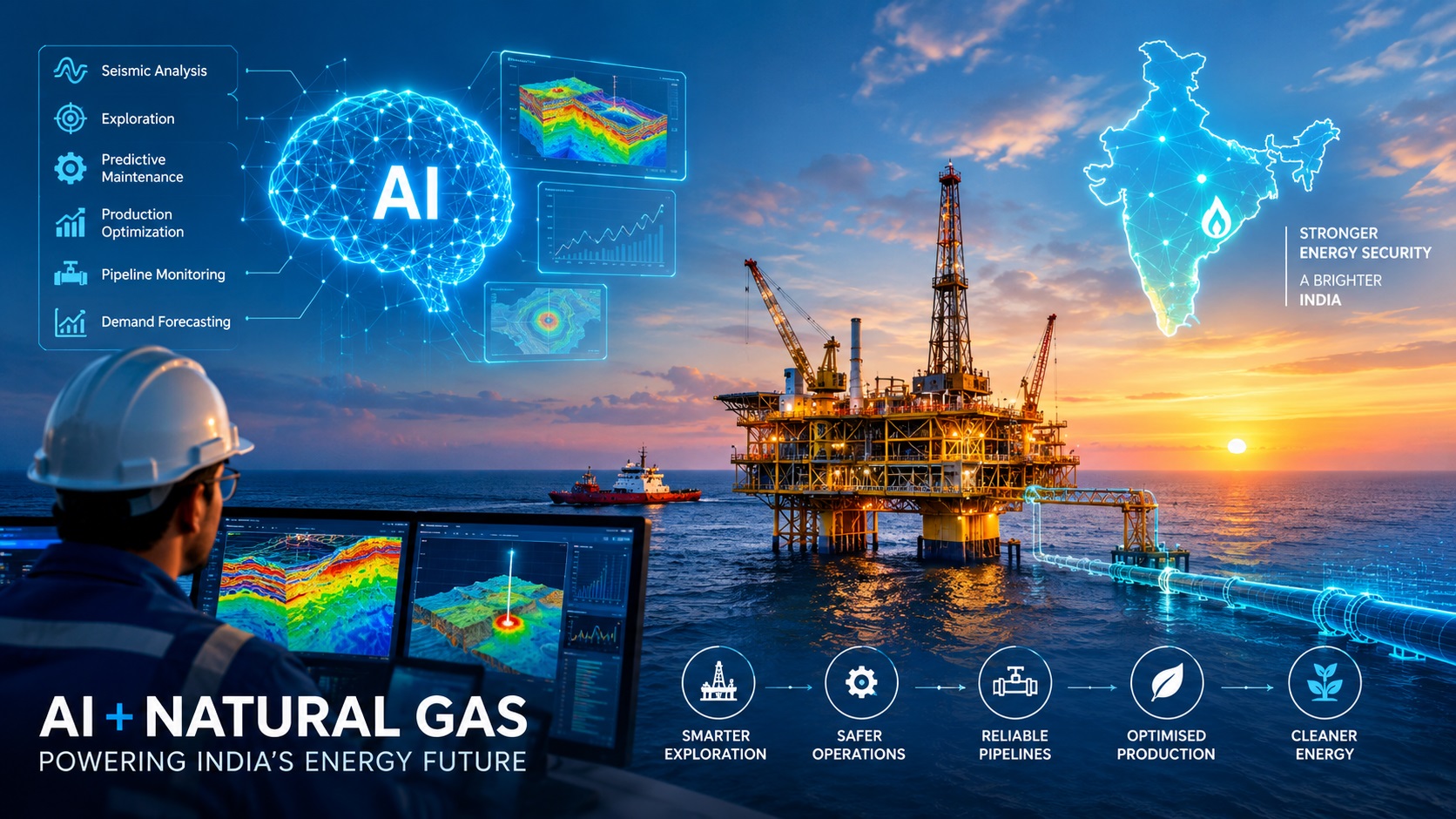
India's energy landscape is entering a new phase. Renewable energy is expanding rapidly, electricity demand is increasing and the country continues to search for ways to strengthen domestic energy production.
Natural gas remains an important part of this transition. It supports industries including fertilisers, manufacturing, power generation and city gas distribution while India builds a broader and more diversified energy system.
At the same time, India's offshore exploration story is moving into deeper waters. A recent gas discovery in the Mahanadi Offshore Basin has brought renewed attention to the country's eastern offshore energy potential.
The bigger technological question is this: What happens when India's expanding natural gas exploration meets artificial intelligence?
What Is AI in the Natural Gas Industry?
AI in the natural gas industry refers to the use of machine learning, predictive analytics, computer vision, intelligent automation and other AI technologies to analyse energy data and support operational decisions.
The industry generates enormous amounts of information from seismic surveys, drilling operations, wells, pipelines, sensors and production facilities.
AI can process these datasets and identify patterns that may be difficult to detect manually.
The objective is not simply automation. The bigger opportunity is to turn large quantities of industrial data into better decisions.
Why AI Could Be Important for India's New Gas Discoveries
Discovering natural gas beneath the seabed is an expensive and technically difficult process. Exploration companies have to interpret geological information, analyse seismic data and decide where drilling could have the greatest probability of success.
AI can potentially help exploration teams rank prospects, identify patterns in seismic datasets and compare geological information at much greater scale.
For India, this could become increasingly important as exploration moves into deepwater and frontier basins.
Mahanadi Gas Discovery and India's Deepwater Opportunity
In September 2026, ONGC announced that it had struck gas in the Mahanadi Offshore Basin under the Samudra Manthan initiative.
The MN-DW18-1-H-D well was drilled to a target depth of 1,623 metres, with the reported gas strike occurring in the 1,441–1,452 metre interval. ONGC said the well was flowing gas with encouraging flow and reservoir pressure during its initial testing.
The discovery is significant, but it should not be interpreted as an immediately commercial gas field. Further appraisal and commercial evaluation are required to determine the resource's development potential.
That distinction matters because AI could play a role not only in finding resources but also in analysing the huge amount of geological and operational information generated after a discovery.
1. AI Can Improve Natural Gas Exploration
Traditional exploration relies heavily on geological interpretation, seismic analysis and the experience of specialist teams.
AI can add another analytical layer.
Machine-learning models can examine large geological and seismic datasets and identify patterns associated with potentially promising structures.
This can help exploration teams prioritise prospects for additional investigation and potentially reduce uncertainty before drilling.
2. AI Can Analyse Seismic Data Faster
Seismic surveys generate enormous volumes of information about underground geological structures.
AI-assisted seismic interpretation can help identify subtle patterns, classify geological features and highlight areas that deserve closer human examination.
The benefit is potentially significant in deepwater exploration, where drilling decisions can involve substantial capital and logistical complexity.
3. Predictive Maintenance for Offshore Gas Operations
Finding gas is only the beginning.
Once a field becomes operational, companies must maintain wells, compressors, pumps, subsea equipment and processing systems.
AI-based predictive maintenance can analyse sensor information and detect unusual behaviour before equipment failure occurs.
Instead of relying entirely on fixed maintenance schedules, operators could increasingly use data to predict when equipment may require attention.
4. AI Can Optimise Gas Production
Production optimisation is another major opportunity.
AI systems can analyse pressure, temperature, flow rates, historical production and other operational variables to identify relationships and potential improvements.
This could help engineers understand changing well behaviour and make better-informed production decisions.
5. Smarter Natural Gas Pipelines
India's natural gas network connects production facilities with industrial users, fertiliser plants, power generation and city gas distribution.
AI can monitor pipeline pressure, flow and temperature data to identify abnormal patterns.
In the future, intelligent pipeline systems could combine sensor information with historical data, weather information and geographic data to detect potential problems earlier.
6. AI Can Improve Energy Demand Forecasting
Natural gas demand changes according to industrial activity, weather, electricity requirements, fertiliser production and other economic factors.
AI-based forecasting can analyse historical consumption together with external variables to estimate future demand.
More accurate forecasts can help companies plan production, transportation and supply more efficiently.
7. AI and India's Energy Security
Domestic energy production has strategic importance for India because the country remains exposed to international energy prices and global supply disruptions.
Increasing the efficiency of domestic exploration and production could therefore contribute to greater energy resilience.
AI cannot create natural gas. What it can do is improve the decisions surrounding exploration, development and infrastructure.
In simple terms: AI is not the energy resource. It is the intelligence layer around the resource.
8. AI Could Reduce the Cost of Exploration
Offshore drilling can require significant investment. Every improvement in prospect selection can therefore have an economic impact.
If AI helps exploration teams identify higher-quality prospects, detect anomalies earlier or analyse geological information faster, it could potentially improve the economics of exploration programmes.
9. Digital Twins Could Transform Gas Operations
One of the more advanced applications of AI is the development of digital twins.
A digital twin is a virtual representation of a physical asset or system that can be continuously updated using real-world data.
For the natural gas industry, digital twins could represent wells, processing facilities, pipelines or entire production systems.
AI could analyse the digital model and help operators test possible scenarios before changing real-world operations.
10. AI, Robotics and the Future of Offshore Gas
The combination of AI and robotics could further change offshore operations.
Autonomous or remotely operated systems could assist with inspection, monitoring and routine tasks in environments where sending humans can be expensive or risky.
AI could analyse images from inspection robots and identify corrosion, structural damage or other anomalies.
This could eventually create a more automated offshore production environment.
Smart Copy PRO
Turn copied text into summaries, professional emails and LinkedIn-ready content in seconds.
Get Smart Copy PRO →Challenges of Using AI in the Natural Gas Industry
AI is not a magic solution.
The quality of an AI system depends heavily on the quality of its data. Incomplete, inaccurate or poorly structured industrial datasets can produce unreliable results.
Cybersecurity is another major consideration because modern energy infrastructure increasingly depends on connected digital systems.
There is also the question of explainability. Decisions involving expensive wells, production systems and safety infrastructure require human oversight.
For these reasons, the most realistic future is not AI replacing energy professionals. It is AI working alongside geologists, engineers, operators and researchers.
What India's AI-Powered Gas Industry Could Look Like
Imagine an exploration platform where seismic information is continuously analysed by machine-learning systems while geoscientists review the most promising geological patterns.
Imagine offshore equipment detecting unusual vibration before a major failure occurs.
Imagine pipelines continuously monitoring pressure and flow while AI systems search for anomalies.
And imagine production systems that learn from historical and real-time information to support better operational decisions.
These technologies do not operate independently. Together they form a connected digital energy ecosystem.
Key Takeaways
- AI can help natural gas companies analyse geological and seismic data more efficiently.
- Machine learning can support predictive maintenance and production optimisation.
- AI can improve monitoring of pipelines and other energy infrastructure.
- India's deepwater exploration creates a major opportunity for data-driven energy technology.
- The Mahanadi gas discovery demonstrates the continuing potential of India's offshore energy frontier.
- AI will most likely augment engineers and geoscientists rather than replace them.
- The future energy industry will increasingly combine physical infrastructure with intelligent digital systems.
Frequently Asked Questions
How is AI used in the natural gas industry?
AI can be used for seismic interpretation, exploration analysis, predictive maintenance, production optimisation, pipeline monitoring, equipment inspection and energy demand forecasting.
Can AI help India discover more natural gas?
AI cannot create geological resources, but it can analyse geological, seismic and drilling data to help exploration teams evaluate potential prospects more efficiently.
What is the Mahanadi gas discovery?
The Mahanadi discovery refers to the gas strike announced by ONGC in September 2026 at the MN-DW18-1-H-D deepwater well off Odisha under the Samudra Manthan initiative.
Will AI replace oil and gas engineers?
AI is more likely to assist engineers and geoscientists. Human expertise remains essential for geological interpretation, engineering decisions, safety and commercial evaluation.
Can AI reduce natural gas production costs?
AI may help reduce operational costs by improving predictive maintenance, production optimisation, equipment monitoring and decision-making. Actual savings depend on data quality and implementation.
Conclusion
India's natural gas future will depend on more than discovering new resources. It will also depend on how efficiently those resources can be explored, developed and managed.
The Mahanadi gas discovery shows that India's offshore energy frontier continues to evolve. As exploration moves into deeper and more technically demanding environments, the amount of geological and operational data will continue to grow.
That is where artificial intelligence could become increasingly important.
From seismic interpretation and exploration to predictive maintenance, pipelines, production optimisation and energy forecasting, AI has the potential to turn massive volumes of industrial data into useful intelligence.
The biggest opportunity may therefore not be AI replacing the energy industry, but AI making the energy industry more intelligent.
India's next natural gas frontier could be deeper, smarter and increasingly AI-powered.
Explore More on BITOMANCY
Want more practical AI and technology guides? Visit the BITOMANCY homepage for more articles on artificial intelligence, automation, SEO and emerging technology.