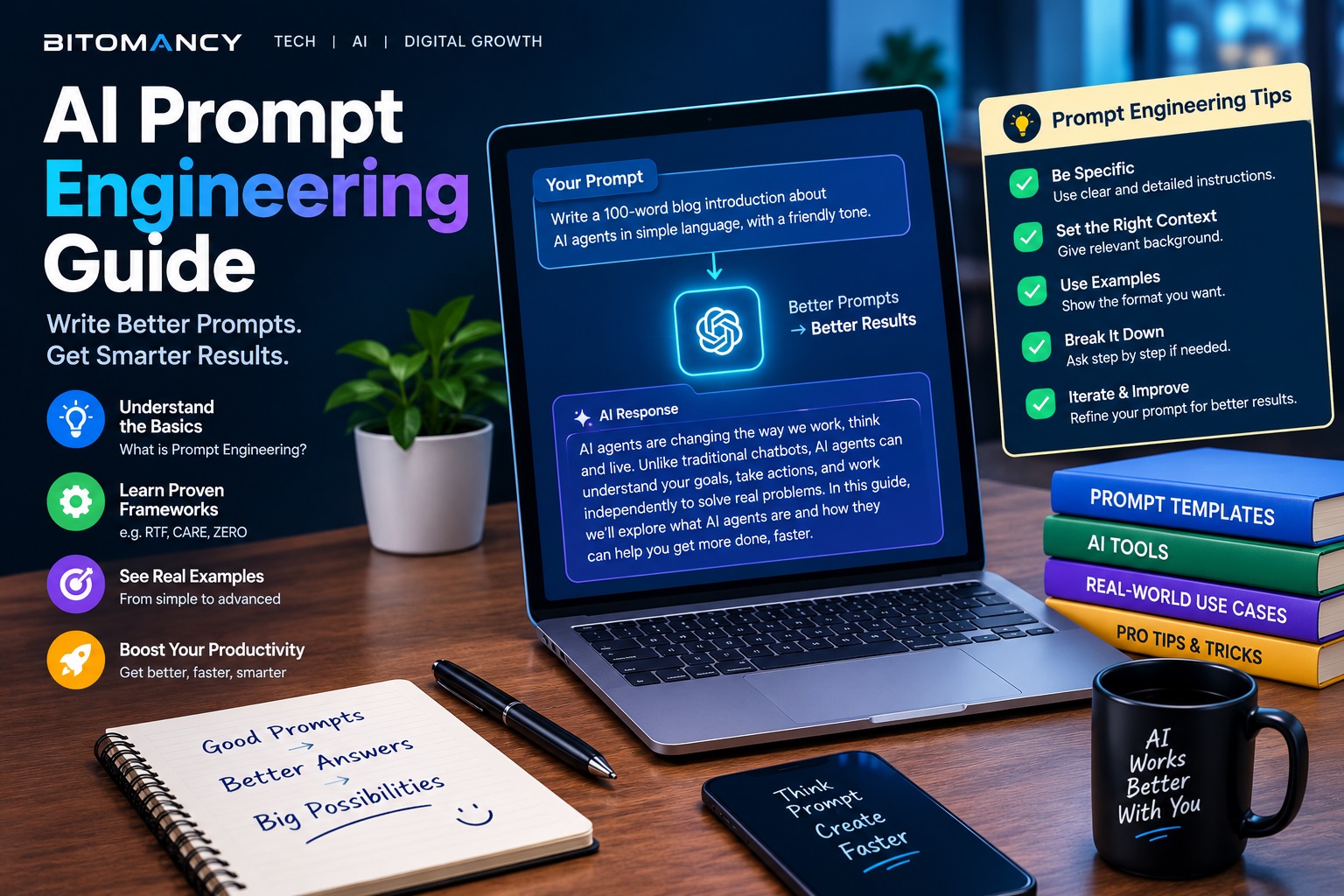
If AI tools keep giving you generic, bloated or slightly wrong answers, the problem usually isn't the tool. It's the instruction. A prompt that is clear about the goal, the audience and the format gets dramatically better output than a one-line request.
This guide gives you a simple structure, seven reusable frameworks and ready-to-copy templates you can use today for writing, research, editing and code.
In This Guide
- What is prompt engineering?
- The 5 building blocks of a strong prompt
- Weak vs strong prompts
- 7 frameworks you can copy
- Ready-to-use prompt templates
- Common mistakes
What Is Prompt Engineering?
Prompt engineering is the practice of writing clear instructions so an AI model produces accurate, useful and well-formatted output. It is less about magic phrases and more about clarity: telling the model who it is, what to do, what it needs to know, and what a good answer looks like.
The 5 Building Blocks of a Strong Prompt
- Role: who the AI should act as, such as an SEO editor or a data analyst.
- Task: the exact job to do, stated as a clear action.
- Context: background, audience and constraints the model cannot guess.
- Format: the shape of the answer, such as a table, bullets, word count or tone.
- Examples: one or two samples of what "good" looks like.
Weak vs Strong Prompts
Weak: "Write about SEO."
Strong: "Act as an SEO editor. Write a 600-word beginner's introduction to on-page SEO for Indian bloggers. Use simple English and three H2 headings, and end with a 5-point checklist."
The strong version removes guesswork. The model knows the role, topic, audience, length, structure and ending, so the first draft is far closer to what you wanted.
7 Prompt Frameworks You Can Copy
1. RTCF: Role, Task, Context, Format
Your everyday default. State the role, the task, the context and the output format in that order. Most good prompts are a variation of this.
2. Few-Shot Prompting
Show two or three examples of the style or structure you want, then ask for a new one. Models copy patterns well, so examples often work better than long descriptions.
3. Step-by-Step Reasoning
For analysis, planning or math-style problems, ask the model to work through the problem in stages before giving a final answer. This tends to reduce careless mistakes.
4. Critique and Revise
Ask for a draft first. Then ask the model to critique that draft against your criteria, such as clarity, accuracy and tone, and produce an improved version.
5. Constraint-First
State the limits up front: length, banned phrases, reading level, required keywords. Constraints stop the model from drifting into generic filler.
6. Persona and Audience
Define both the writer and the reader, for example "explain this as a teacher speaking to a Class 10 student." Naming the audience changes vocabulary, depth and examples.
7. Prompt Chaining
Split a big job into steps: research, outline, draft, edit. Feed the output of each step into the next. This is the foundation of any AI-powered workflow, and it is also how AI agents break complex goals into manageable actions.
Smart Copy PRO
Turn copied text into summaries, professional emails and LinkedIn-ready content in seconds.
Get Smart Copy PRO →Ready-to-Use Prompt Templates
Copy these, replace the brackets and adjust to your needs.
- Blog outline: "Act as a content strategist. Create an outline for an article on [topic] for [audience]. Include H2 and H3 headings, the search intent, and 5 FAQs."
- Editing: "Edit the text below for clarity and concision. Keep my meaning and voice. List the changes you made."
- Code help: "Here is my code and the error message. Explain the cause first, then give the smallest fix that solves it."
- Summary: "Summarize the text below in 5 bullet points for a busy manager. Put the most important point first."
- Fact-check pass: "List every factual claim in this draft and mark which ones need a source."
Common Prompt Mistakes
- Being vague about the audience or goal.
- Asking for too much in one prompt. Break big jobs into steps.
- Not providing source material when accuracy matters. Paste the facts you want used.
- Trusting output without checking. AI models can produce confident errors, so always verify names, numbers and claims.
- Never iterating. Treat the first answer as a draft and refine it with follow-up instructions.
Safety and Quality Tips
Do not paste passwords, private customer data or confidential documents into public AI tools. Review all AI-assisted content before publishing, and add your own experience and judgment so the final result is genuinely yours.
Key Takeaways
- Clear prompts beat clever prompts. Give role, task, context and format.
- Examples and constraints improve results more than long descriptions.
- Chain simple prompts together for complex work.
- Always fact-check AI output before you use or publish it.
- Save your best prompts in a personal library for reuse.
Frequently Asked Questions
What is prompt engineering?
Prompt engineering is the practice of writing clear instructions so an AI model produces accurate, useful and well-formatted output. It means telling the model its role, the task, the context and the format you want.
Is prompt engineering still relevant as AI models improve?
Yes. Better models understand intent more easily, but clear goals, context and constraints still produce noticeably better results on every model.
Do longer prompts work better?
Only when the extra detail is relevant. A clear, focused prompt beats a long, vague one.
Should I save my prompts?
Yes. Keeping a personal prompt library for repeat tasks such as outlines, editing and summaries saves time and keeps quality consistent.
Conclusion
Better results from AI don't require technical skill. They require clear thinking: know what you want, say who it's for, and show what good looks like. Start with the RTCF framework, add examples and constraints when you need more control, and chain prompts together for bigger projects.
Explore More on BITOMANCY
Want more practical AI and technology guides? Visit the BITOMANCY homepage for more articles on artificial intelligence, automation, SEO and emerging technology.