This month's AI trend roundups keep returning to the same idea: the biggest business win isn't another chatbot, it's one supervised agent that does real work. Agentic AI frameworks are the building blocks behind that shift.
If you have read our explainer on what AI agents are, this guide is the next step. It covers what frameworks do, the features that matter, the options developers commonly compare, and how to pick one without wasting weeks.
In This Guide
- What is an agentic AI framework?
- Key features to look for
- Popular frameworks developers compare
- How to choose
- Build your first agent in 6 steps
- Risks and safeguards
What Is an Agentic AI Framework?
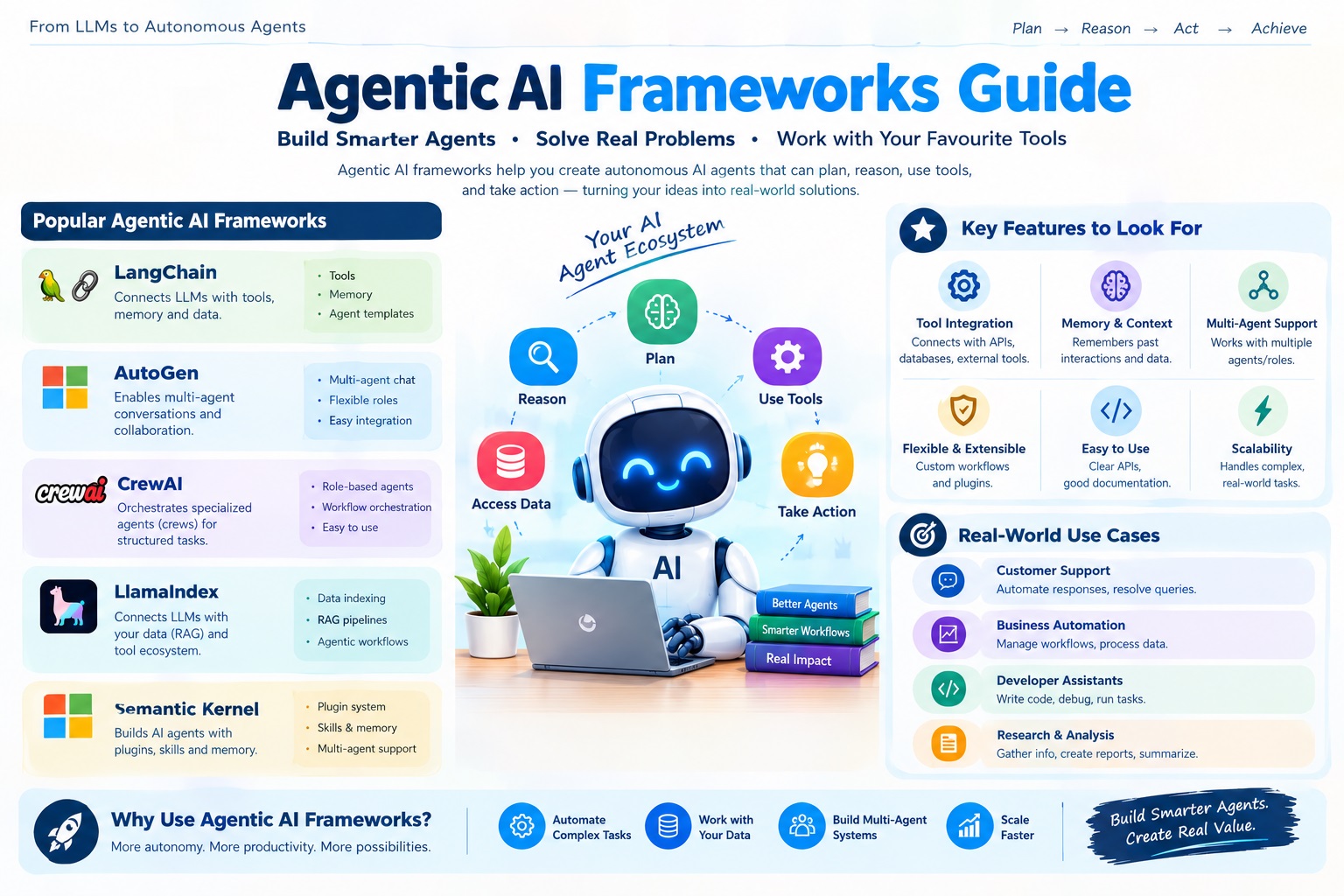
An agentic AI framework is a software toolkit that helps developers build AI agents that can reason, plan, use tools, keep memory and complete multi-step tasks. Instead of writing every piece of orchestration code yourself, you get ready-made components for connecting a language model to tools, data and workflows.
A framework is optional. A simple agent can be just a model API call inside a loop. Frameworks earn their place when your system needs several agents, long-running tasks, memory, retries and monitoring.
Key Features to Look For
- Tool use: easy ways to connect APIs, databases, search and code execution
- Orchestration: control over steps, branching, loops and retries
- Memory and state: keeping context across steps and sessions
- Multi-agent support: letting specialized agents collaborate
- Human-in-the-loop: pause points for approval on risky actions
- Observability: tracing and logs so you can debug what the agent did
- Model flexibility: freedom to switch model providers
- Community and maintenance: active development and good documentation
Popular Frameworks Developers Compare
The landscape changes quickly, so check each project's current documentation before committing. These are names you will commonly see in comparisons:
- LangGraph (LangChain ecosystem): graph-based control over agent steps and state, popular for complex, controllable workflows
- CrewAI: role-based teams of agents, often chosen for quick multi-agent prototypes
- AutoGen: conversation-style multi-agent collaboration, originating from Microsoft Research
- LlamaIndex: strong on connecting agents to your own documents and data
- Provider SDKs: several model providers offer their own agent toolkits, which can be the simplest route if you use one model family
No single option is best for everyone. The right choice depends on your task, your team's skills and how much control you need.
Smart Copy PRO
Turn copied text into summaries, professional emails and LinkedIn-ready content in seconds.
Get Smart Copy PRO →How to Choose
- Start from the task. Is it a fixed pipeline or open-ended? Fixed steps often need a workflow, not a free-roaming agent.
- Count the agents. One agent with tools may not need a framework at all.
- Weigh control vs speed. Graph-style tools give precision. Role-based tools give faster prototypes.
- Check observability. If you can't see what the agent did, you can't fix it.
- Test with a small real task in two frameworks before standardizing.
Our guide on building an AI-powered workflow shows how to map the input-to-result loop before you pick any tool.
Build Your First Agent in 6 Steps
- Pick one narrow goal, such as "summarize new support emails and draft replies."
- List the tools it needs, such as email access and a knowledge base. Grant read-only access first.
- Write a clear instruction prompt with role, rules and output format. See our prompt engineering guide.
- Add guardrails: limits on actions and a human approval step before anything is sent.
- Test on real examples, including messy and tricky ones, and log every step.
- Review and expand slowly, adding capabilities only after the basics are reliable.
Risks and Safeguards
- Over-permissioned agents: give the minimum access needed
- Prompt injection: web pages or emails can contain hidden instructions, so treat outside content as untrusted
- Runaway cost: set limits on steps, time and spend
- Silent errors: require logs and spot checks
- Accountability: a named human should own the outcome
For a deeper look at controls, read our guide to AI guardrails and responsible AI.
Key Takeaways
- Frameworks speed up agent building but aren't required for simple cases.
- Prioritize tool use, orchestration, memory, human approval and observability.
- Choose by task and team skills, and test two options on a real job.
- Start narrow, read-only and supervised, then expand.
- Always verify current features in each project's official documentation.
Frequently Asked Questions
What is an agentic AI framework?
An agentic AI framework is a software toolkit that helps developers build AI agents that can reason, plan, use tools, keep memory and complete multi-step tasks, without writing all the orchestration code from scratch.
Do I need a framework to build an AI agent?
No. A simple agent can be built with a model API and a loop. Frameworks become useful when you need multiple agents, memory, tracing, retries and complex workflows.
What is the difference between an AI agent and a workflow?
A workflow follows predefined steps. An agent decides its own next steps toward a goal. Many real systems combine both, using fixed steps with agent decisions where flexibility is needed.
Are AI agents safe to use in production?
They can be, with limits on permissions, human approval for risky actions, logging and testing. Start with low-risk tasks and expand gradually.
Conclusion
The best agentic AI framework is the one that fits your task, your team and your risk tolerance. Begin with a small, supervised project, measure what it saves you, and let results, not hype, decide how far you go.
Explore More on BITOMANCY
Want more practical AI and technology guides? Visit the BITOMANCY homepage for more articles on artificial intelligence, automation, SEO and emerging technology.